
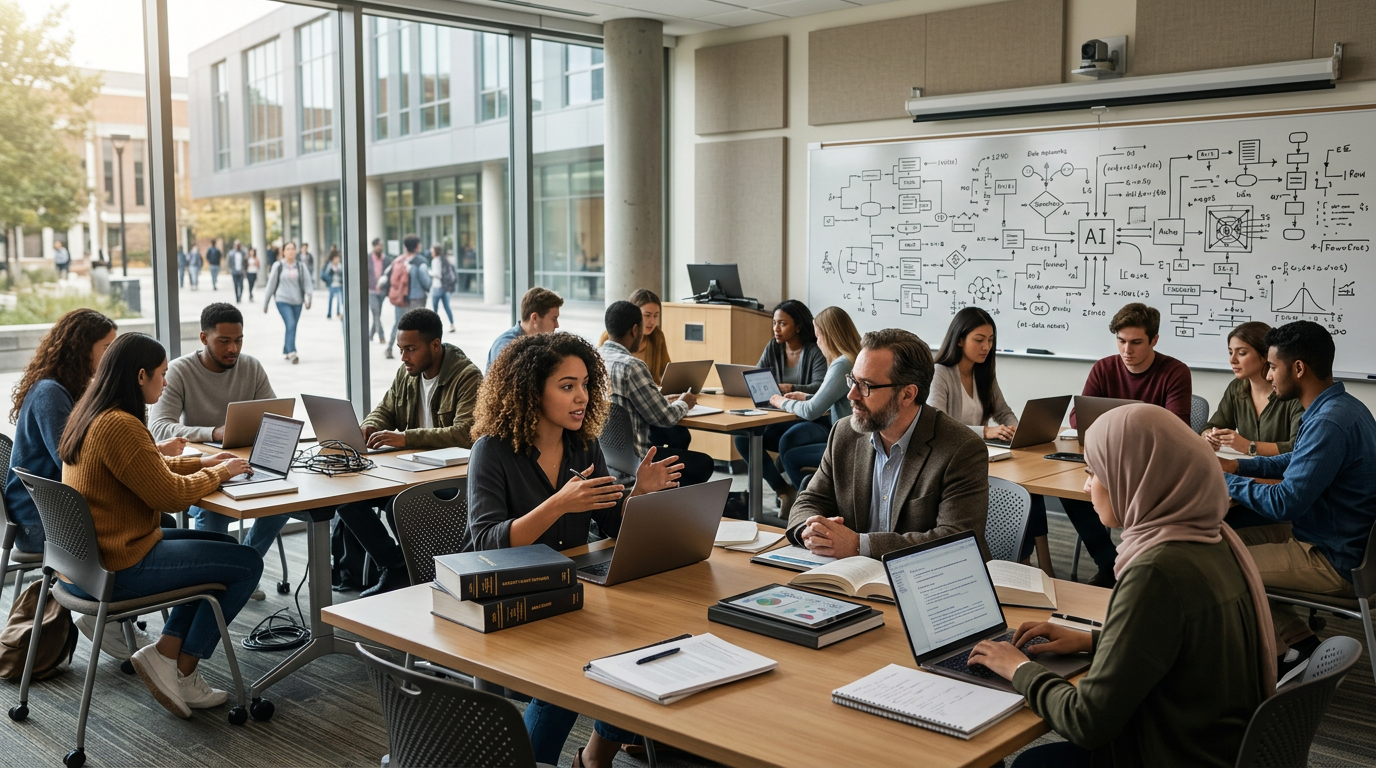
An AI tutor belongs beside the student while they are learning. It does not belong in the unsupervised task that is supposed to show what they can do alone. Three stories this week look unrelated until you put them next to each other. An academic using AI to represent himself against an experienced legal team. A state government deciding it can no longer trust take-home assessment. And a web that is now read more often by machines than by people. Each one is a version of the same shift: these tools are no longer sitting on the side of the work. They are inside it.
What we mean by an AI tutor is set out on the AI tutor for schools page.
A self-represented win
A Macquarie University academic represented himself at the Fair Work Commission, using ChatGPT and Claude to research the law, test arguments, anticipate the other side and check every citation. He won against an experienced legal team. The AFR called it a landmark.
I do not read this as "AI replaces lawyers". I read it as a reminder that a capable person, given tools that can search, structure and stress-test an argument, can go much further than the old cost of entry suggested. The citations still had to be checked. The judgement still had to be his. The leverage is real, and so is the obligation to use it carefully.
An AI tutor is not the HSC assessment
Some people expect me to be worried about this week's HSC announcement. I am not.
Moving unsupervised assessment back into the classroom is the right call. Teachers currently have no reliable way to know whether a take-home essay was written by the student or by Gemini or ChatGPT, and detection tools are too unreliable to stake a student's future on.
I think the Deputy Premier got the framing right too. In her words, AI has "enormous potential to support teaching and learning", but it should never replace the thinking, creativity and hard work that education exists to develop.
AI products are designed to either get an answer as fast as possible, or help you find that answer yourself through learning. CurricuLLM does the latter. Students answer every question in their own words or voice, so the knowledge ends up in their heads. Questions adapt to each student's level, aiming for the zone of proximal development. Teachers see capability building week by week, so they can use that data as an additional signal for assistance or intervention.
This week's announcement confirmed the outcome we are building towards is the right one.
Machines now request more pages than people
How did I miss this? AI systems now request more web pages than humans do, every day. Cloudflare's data put bot traffic to HTML pages at around 57 per cent, with humans at 43 per cent. Matthew Prince had thought this crossover would wait until 2027.
It is worth being precise about what the number means. It is requests, not attention. Humans still spend the time. Machines now fetch the pages, often to answer a question a person never has to visit the source to ask. That is a quiet change in who the web is for, and it will force a lot of assumptions about publishing, attribution and traffic to be rewritten.
Experiment in daily work, then measure
I had a great time this week at Clutch Events' Sydney Enterprise AI and Automation gathering, talking about how AI is changing roles, teams and skills. The live voting format was a highlight: the audience voted on real workplace scenarios, and we unpacked the results together.
What was clear from the sessions is that the organisations making real progress are the ones experimenting with AI in daily work and paying close attention to what actually changes. Not the ones with the most slides about transformation. The ones measuring it.