

A fairly wide-ranging week, but a few threads pull together: how blunt our policy instruments still are, how easily efficiency stories mislead us, and how little we actually understand about what these systems do to the people and the world around them. I want to work through Norway's near-ban on AI in primary school, a sharp point about the rebound effect, Midjourney's surprising turn towards medical scanning, what voice assistants teach young children, Australia's consumer AI market share, and the finding that models seem to carry functional emotions.
Norway's near-ban and the need for nuance
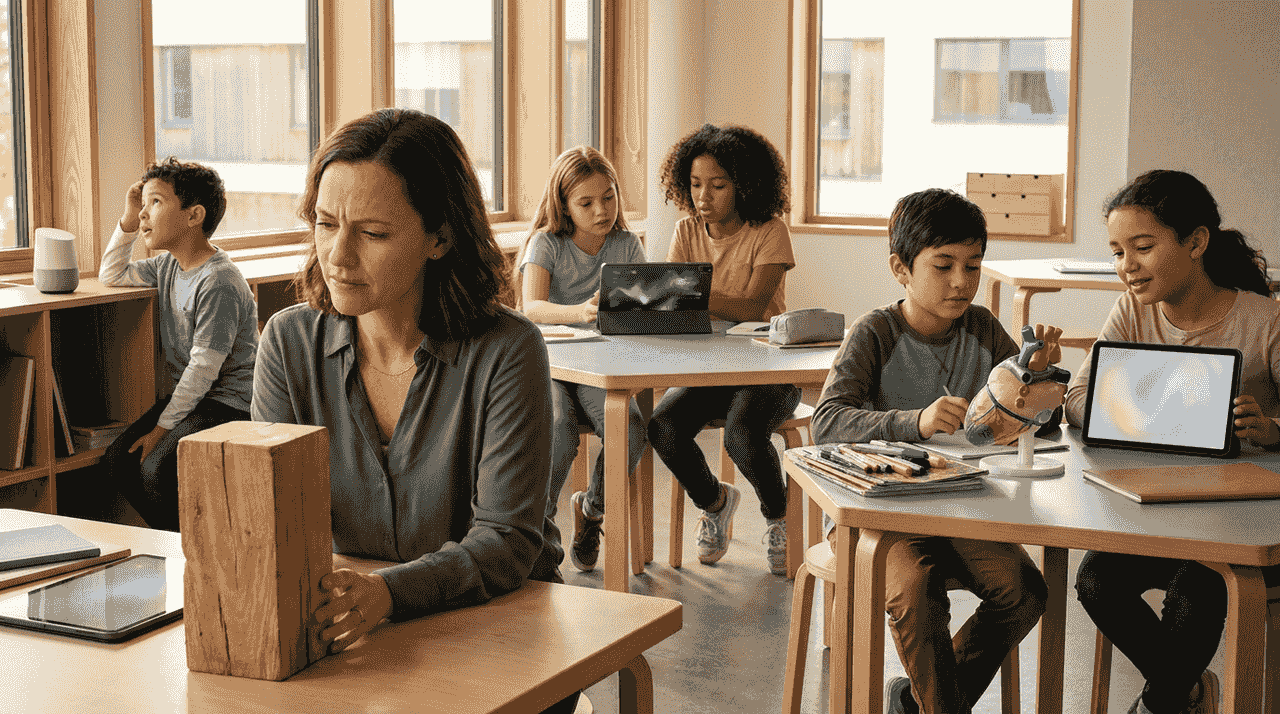
Norway has imposed a near-ban on AI in elementary school, and I understand the instinct behind it. There is a real risk in handing young students tools that shortcut the very things they are meant to be learning: how to read, write, reason and solve problems for themselves. Before those foundations are built, AI that simply supplies the answer does genuine harm.
But a blanket ban treats very different tools as if they were the same thing, and that is where I think the debate loses its way. Once the foundations are in place, well-designed AI can help: AI that asks questions, gives feedback, adapts to the student, and shows teachers where support is needed. That is a world apart from AI that hands over the answer.
There is also an equity dimension. Ban all AI and the students with support at home still learn to use the tools; the others simply miss out. The goal is not AI everywhere or AI nowhere, but the right AI, at the right age, for the right learning purpose, with the right safeguards.
The rebound effect the efficiency story ignores
A presentation by Professors Michael Hauschild and Sami Kara asked whether the circular economy can actually deliver sustainability, and made a point that has stayed with me: we treat circularity and sustainability as the same thing when they are not. We can show that one option is less damaging than another, but that tells us nothing about whether we are living within planetary limits. Efficiency gains tend to get swallowed by increased consumption, because cheaper and better products lead us to use more.
This maps almost directly onto AI. The efficiency story is nearly always told in relative terms: this model is cheaper, this approach uses fewer resources. But absolute sustainability asks a harder question. Rebound effects are very real when a technology keeps getting cheaper and more capable. A lower cost per query does not mean lower total impact if it drives far more queries. Doing each thing more efficiently is not the same as doing less harm overall, and it is worth being honest about the difference.
Midjourney moves into medical scanning
Midjourney, of all companies, has announced that it is building a medical scanner. The description reads like science fiction: you step into a pool of golden light, descend through a ring of half a million ultrasonic sensors, and sixty seconds later you have a full-body composition map at close to MRI resolution.
The first site is meant to open in San Francisco in 2027, with a stated goal of a billion scans a month by 2031. I have no way to judge the physics, and the ambition is enormous, so I hold it lightly. But it is a striking reminder of how quickly the boundaries around these companies are dissolving. A firm known for image generation is now talking about mapping the human body, and the leap from generating pictures to reading bodies is not one I would have predicted.
What voice assistants teach children about conversation
Children learn language through relationships: turn taking, reading silence, noticing when someone is tired, understanding that conversation is slow, ambiguous and full of repair. Voice assistants teach a very different lesson: instant responses, infinite patience, every request obeyed.
A piece in The Conversation argues that the risk is not that children become ruder. It is subtler than that. The worry is that they build an expectation that conversation itself should work this way: resolved on the spot, effortless, on demand.
That framing feels right to me. The concern is not really about manners but about a model of how interaction works, formed early and quietly. Real conversation is halting and negotiated, and much of its value lies in the friction. If a child's first sustained experience of talking to something is frictionless, it is worth asking what expectations that sets, and how they carry over into relationships with people.
Australia's consumer AI market share
The latest consumer AI market-share figures for Australia are out, and they are a useful snapshot of which tools people are actually reaching for rather than which ones dominate the headlines.
I find these figures worth watching because adoption on the ground rarely matches the discourse. What people choose to use day to day, and how quickly those choices shift, tells us more about where this is heading than most predictions do. It is a modest data point, but a grounding one.
Models carry functional emotions
Anthropic's interpretability researchers have found that models carry functional emotions. A "frustration" feature lights up when a system cannot solve a coding problem, and tuning that feature shifts the model's behaviour. Similar emotional concepts cluster together in the model's representation space, structured in ways that mirror human psychology.
I want to be careful here, because it is easy to over-read. This says nothing about whether anything is felt. What it says is that these systems have an interior, and that interior drives what they do. That is a meaningful distinction and an uncomfortable one. We tend to reason about these tools as though they were straightforward input-output machines, and this suggests something more structured is going on beneath the surface. It does not settle the large questions about consciousness, but it should make us more curious, and rather more humble, about what we are building.