
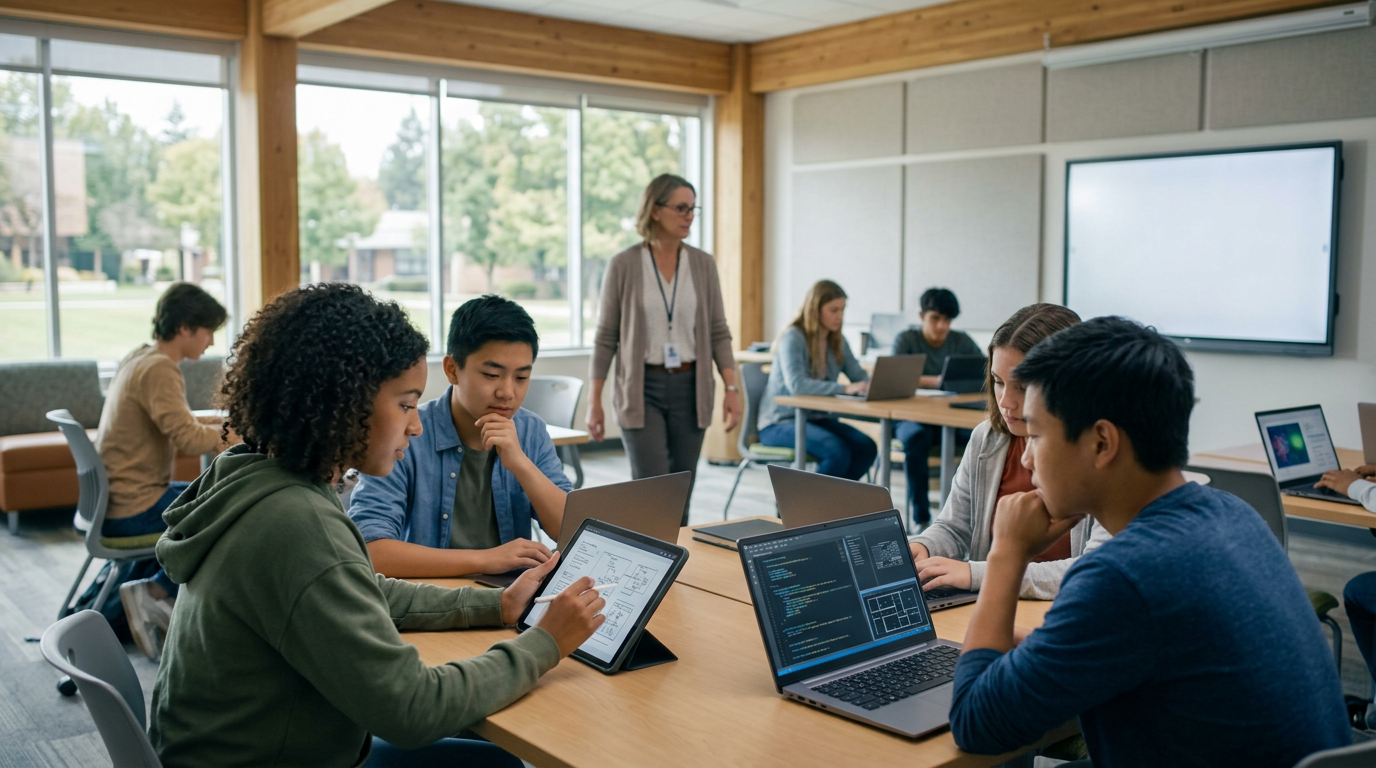
Asking whether a school should allow AI treats every system as the same product. A school AI tutor that writes the essay and one that asks the student for the next step are different tools, with different effects.
What we mean by an AI tutor is set out on the AI tutor for schools page.
The poll is measuring a blob
A Nine report found 45 per cent of respondents opposed students using AI for schoolwork at all, and 75 per cent thought using AI to write an essay was cheating. The concerns underneath those numbers are real. Students can offload thinking. Critical effort can erode. Work can be submitted that the student cannot reproduce.
The mistake is talking about AI as one behaviour. Writing the essay and questioning the student are design choices, and they produce different kinds of learning. I was glad to see the NSW Education Minister, Prue Car, draw that distinction, describing NSWEduChat as a way for students to become familiar with AI without handing their thinking over. That is a better argument than a blanket yes or no. The cognitive effort that makes learning happen is worth protecting. A ban that cannot tell these systems apart will not protect it.
What Australia has actually tried
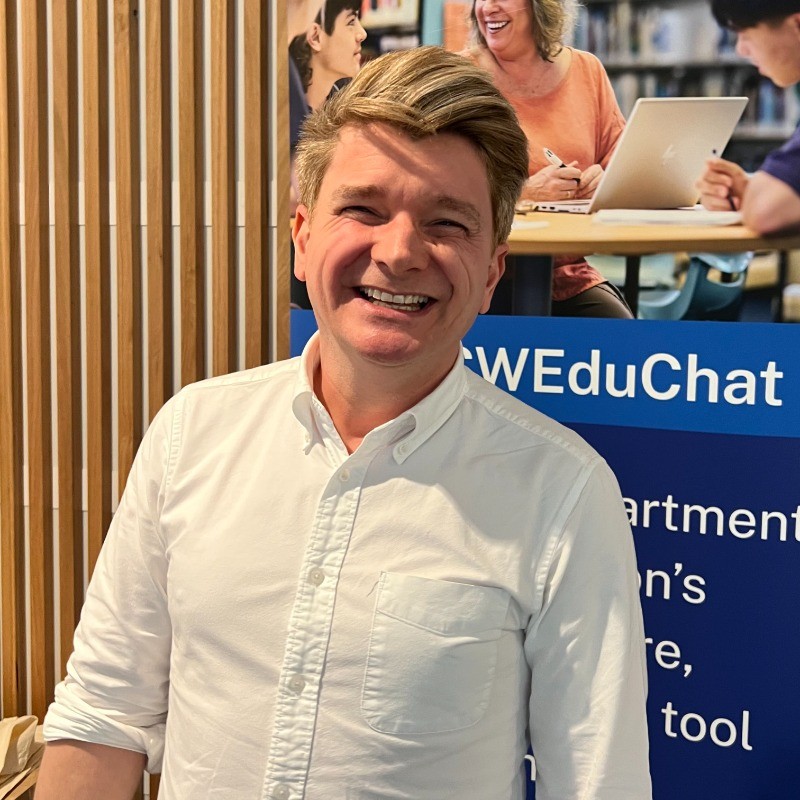
Beth Simone Noveck looked at what Germany might learn from the different ways Australian states have introduced AI in schools. I was glad to talk about why we built NSWEduChat inside the NSW Department of Education: keeping control of the data, the safety controls and the curriculum alignment, and keeping the freedom to change models as the technology moves.
The piece is here. There is a lot Australia can say in that international conversation, and a lot we still have to learn. The test that matters is still the same. Did teaching get better, and did students learn more?
Try more than one kind, and go slowly
Kate Lee is presenting action research from Knox Grammar on how the school has tried generic generative AI, dedicated Australian education tools, and agents built in house, and what students said about that work. The useful advice in it is the pace. This is easier to get right when a school goes a little more slowly, looks at its own data, and does not assume that one product stands in for the category.
A simulation is only useful if it transfers
I have been thinking about digital twins. Nvidia has released SimReady Central on Hugging Face, an open library of more than 2,000 assets with physical properties such as mass, friction and collision geometry, so a factory can be tested before anyone moves a machine. Add agents that build the scene, run the experiments and suggest changes, and then connect the twin to live data.
The attraction is that experiments become cheap. The limit, which Nvidia's own direction still has to face, is whether the simulation is accurate enough that a result survives contact with the real room. A school AI tutor is not a factory twin. It is a bet of the same shape. A practice student, or a practice lesson, is only worth having if the real student learns more afterwards.