
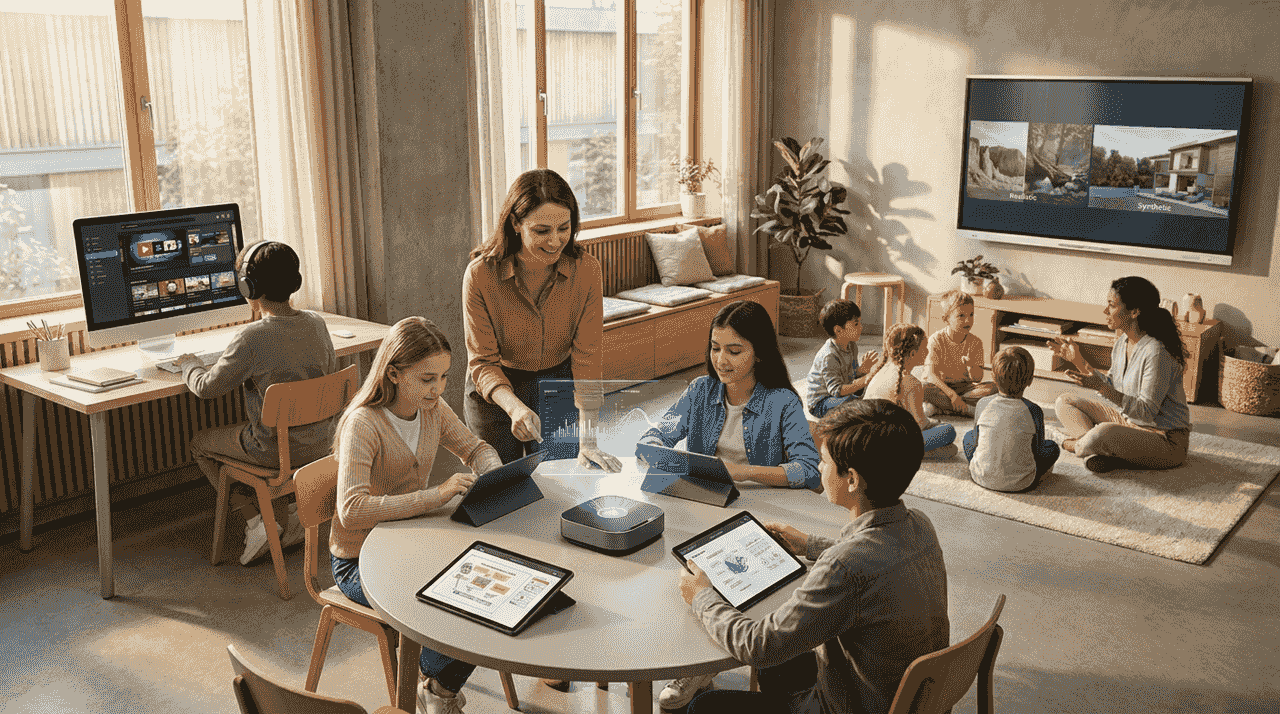
A few developments this week share a common thread: the growing conviction that AI in education should be shaped deliberately rather than left to chance. A UK programme is funding teacher-led, curriculum-aligned tutoring tools; the world's largest student assessment is preparing to measure AI and media literacy; and a small grants fund is helping primary schools teach children to question what they see online. Taken together, they sketch out what a considered approach might look like.
The UK's careful bet on AI tutoring
The UK government's Incubator for Artificial Intelligence, working with the Department for Education, has launched the AI Tutoring Pioneers Programme. It will fund a select group of EdTech companies and AI labs, with around £300,000 per successful bid, to co-design AI tutoring tools for Years 9 and 10 across English, maths, science and modern foreign languages.
What strikes me is that almost everything worth wanting is written into the announcement. The tools are to be co-designed with teachers and aligned to the curriculum. They are to be benchmarked for accuracy, age-appropriateness and safety, built with a privacy-first approach, and directed at closing attainment gaps rather than widening them, with an explicit focus on up to 450,000 disadvantaged pupils a year.
This is the model I keep coming back to: not AI dropped into classrooms in the hope that it helps, but something evidence-led, teacher-led and safety-first from the outset. It is harder and slower work, and that is rather the point.
PISA will start measuring AI literacy
From 2029, PISA will assess AI and media literacy for the first time, with the Australian Council for Educational Research appointed by the OECD to lead the cycle. The new Innovative Domain will test whether students can access, analyse and critically engage with digital information, misinformation and disinformation.
The framing matters. The question is not whether students can operate a particular tool, but whether they can engage proactively, critically and responsibly in digital environments. That is a more durable skill, and a more honest thing to assess, given how quickly the tools themselves change. Consultation begins this year, a field trial follows in 2028, and the main survey runs in 2029.
When the world's biggest education test decides to measure something, systems tend to pay attention. That is precisely why it is worth getting the definition right before the measuring begins.
Equipping schools against misinformation
A new £200,000 fund from Tesco Mobile and Internet Matters will help primary schools across the UK address AI-generated content and misinformation. It offers 100 grants of £1,000, five larger grants of £20,000, and a short educational film for teachers, pupils and parents.
In absolute terms this is a small sum, and I do not want to overstate it. But the direction is right. Children now encounter synthetic images, audio and text as a matter of course, and the useful response is not to shield them from it but to give schools the materials and the confidence to teach them to question what they see.
It fits neatly alongside the PISA shift. If we are going to assess critical engagement with digital information, we also need to fund the teaching that builds it. Modest, practical steps like this are how that capability gets built in ordinary classrooms.