
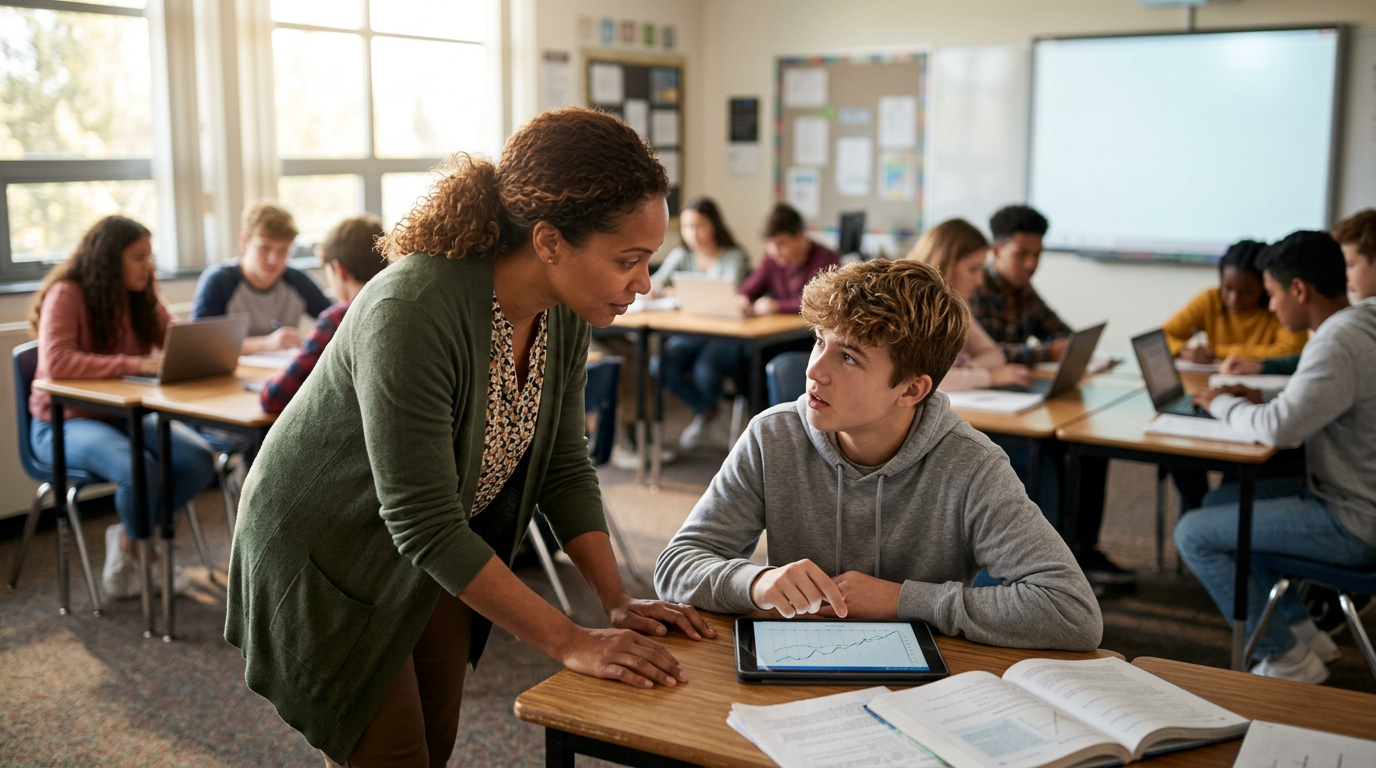
Saving a teacher time is not, by itself, a result. A school AI tutor has helped if that time turns into attention for a student who is stuck.
What we mean by an AI tutor is set out on the AI tutor for schools page.
Time back is not the outcome
Gallup surveyed 1,952 US K–12 educators and found that 59 per cent had used AI for work during the 2025–26 school year. Of those who used it, 64 per cent said it gave them more time for the parts of the job that matter most. Asked what makes them feel they matter, 85 per cent said that helping a student through something difficult does that a great deal.
That is the measurement I want next. Did the saved time become more individual feedback, more attention, or a conversation with a student who was stuck? A release of new features, including the ones schools ask for, should be held to the same question.
The student who is not there
A paper from Microsoft Research and the University of Illinois asks whether an AI tutor can practise on simulated students built from real learner records. That is harder than telling a chatbot to act like someone who is struggling. The simulator has to make mistakes that look like a particular learner's, and then respond when the tutor offers guidance.
StudentSim was tested against records from 60 learners in chess, second-language English writing and mathematics. It beat a prompted GPT-5.4 baseline on both measures they used. A chess tutor trained on the simulator's feedback was also rated higher by people for accuracy, guidance and personalisation.
The limit is the point. The tutor experiment was in chess. The paper measures how a simulator responds to one piece of guidance. It does not show that real students learn more, or remember it. Simulated students are a sensible way to test a tutor before a child uses it. They are not evidence that the tutor works.
A lot of tutoring chats skip the teaching
A Carnegie Mellon study of 1,726 real conversations with 217 teacher-configured educational chatbots is a useful cold shower. Fifty-four per cent of conversations skipped a teaching or workflow step the teacher had required. Thirty-seven per cent buried the learner in too much information or too many questions. Thirty-three per cent never set out how the conversation was supposed to work. Ten per cent contained incorrect content.
Curriculum alignment is one answer to that. A school AI tutor that knows the outcome, and the order in which ideas have to arrive, has something to refuse. It can see what the student already understands and which prerequisite is missing, and it can hold the steps the teacher asked for instead of jumping to a fluent ending.
Australia is not racing
Jacob Greber argued at the ABC that Australia should consider slowing down on AI rather than trying to be first. The concerns he raises are fair: employment, who captures the gains, the cost of data centres, and public trust. I do not accept the premise that Australia is moving too fast.
A great deal of money is going into infrastructure. Building data centres and changing how work gets done are different projects. Deloitte's research earlier in the year found that 12 per cent of Australian organisations believe AI is transforming their business and industry, against 25 per cent globally. In the large organisations I work with, changing an established process is slow, and that slowness is a kind of brake.
Torsten Slok at Apollo published five charts that widen the gap further. Revenue per employee and profit margins are rising for the Magnificent Seven and flat for the other 493 companies in the S&P 500. There is still no clear sign of AI lifting productivity across the wider economy, and the spending is highly concentrated. Ramp data in the same analysis suggests 80 per cent of the top 1 per cent of AI spenders are venture-backed, against 13 per cent of median spenders. Some of the apparent demand is investment capital, not value already earned.
Charts like that do not prove AI is useless. Gains from a general technology can take years. They do suggest that a school should not adopt a school AI tutor because the industry looks busy. It should adopt one because students learn more with it than without it.